Showing posts with label 40k basics. Show all posts

Monday, September 15, 2014

40K army checklist


We had a question for our upcoming 40K league that I thought wouldn't be well-answered by a Facebook reply, so I brought it over here:

It appears that this 40K league will have several new or returning players including myself. One of the things I did was a small checklist for army building when involved with the Fantasy league. This question goes out to the more experienced players:  When creating an army list what items or capabilities do you make sure that it has?

There have been some good replies already, and some of this will overlap.  Keep in mind this is for a pretty casual league.  I don't think we'll see super-tough top meta builds or anything like that; the advice is more geared to being sure you have options and aren't blindsided.

So, what should I keep in mind while building a 40K army?  The more you can answer with a yes the better, but you don't necessarily need all of them.  There are multiple ways to do most things, and a single unit can do multiple things, but be careful of relying too much on any one unit.  A lot of things also come down to how you use something, not just the army build itself.  Caveats aside:

  • Can I secure objectives on my side of the table? (Can I have units be there at the end of the game? Can they survive?)
  • Can I secure objectives on the other side of the table/get Linebreaker?
  • Can I get First Blood and protect myself against it?
  • Can I get Slay the Warlord and protect myself against it? (Do you have ways to protect your own Warlord?  Do you have ways to pick out the enemy Warlord?)
  • Can I handle hordes?
  • Can I handle elite infantry (2+ saves)? (either weapons that can bypass the saves or ability to kick out enough wounds they are bound to fail saves)
  • Can I handle high AV vehicles and high Toughness targets? (some things work against both, some only vs one - poison is great against T8 but lousy against AV for example)
  • Do I have a way to ignore cover?
  • Do I have a way to get at somebody hiding? (Fast units, indirect fire)
  • Can I handle flyers? (Skyfire, buckets of dice or ability to weather them?)
  • Is my army fun to play against? (Great point by one of our players, Will!)
  • Is my army fun to play?
A word on flexibility - be sure to take a second look at things that inherently offer extra flexibility.  Things like missile launchers, with different fire modes or psykers that can look at the mission and the opposition before deciding what disciplines to go for.

Other things?  Things you think are more important than others?

Thursday, August 15, 2013

40K Basics: Scale


Just a quick bit to add to the 40K Basics archives - scale in 40K.  Not the scale of the models or the battlefield, or how silly it is that a bolter can only shoot as far as a man can run in 2-4 turns (or how long a turn is...).  Rather, how the scale of a game can affect how powerful something can be.

Tuesday, October 2, 2012

6th edition 40K impressions, continued: Winning


So 6th ed has been out for a few months, and having played a number of games now I've formed some opinions, as have we all by now I'm sure.  Here's mine, let's see what we might agree or disagree on.

Tuesday, July 24, 2012

Eleventhification

Just a quick 11th Company related post from the road. Apologies for lack of links; the iPad and I haven't fully worked this out yet. First, I have a brief interview with Pat on episode 127 of the 11th Company about the 6th edition impressions series. If you're finding your way here from there, you can use the labels or hop to the 40k Basics tab up top for the series. Second, I'm near their stomping grounds, and have duly arranged to meet them and get stomped! My Deathfin and IG allies have an appointment to get crushed by Pat and a bunch of daemons and csm. I expect to have breath/wind of chaos nightmares for a while. I'm sure you can hear about it on ep. 128 and hopefully see pics here next week!

Thursday, July 19, 2012

6th Ed Impressions, Part Ten - Instrumental Changes


 As I've gone through this series of posts, looking at the different rules and using them in-game, I've come to see some of what may be the rationales for some of the ways rules work in combination, and I've also gotten some ideas for things I would have liked to have seen included.

In no particular order:

Wednesday, July 18, 2012

6th edition 40K - Dawn of a New Era


With 6th edition Warhammer 40,000 out, there may be a number of new or returning players thinking about coming to the game.  I just wanted to point to some links that might help.

For new players especially, the links in the HEY SONS! tab above may be helpful, providing a starting place for information about models and modeling, the background, various factions, as well as some advice on making smart purchases.  I'm also happy to help new folks out and enjoy talking about all this stuff, so feel free to email me through the contact info on the right.  I will warn you that my free advice may be worth exactly what you pay for it!

For returning players, or those who have yet to read the new rules, my series on 6th Edition Impressions talking about some of the changes from 5th edition and the implications has been added to the 40K Basics tab above, hopefully a more convenient place to find it.  Let me know what you think, and feel free as always to add in the comments on the relevant post what I may have missed, gotten wrong, or your ideas on what the changes mean for our games going forward.  Note that some of the older 40K Basics articles specifically talk about 5th edition rules - I've noted them where it's especially relevant so hopefully folks won't get confused, but I'll leave them up for posterity and vanity's sake.  For the most part, anything prior to June 2012 will be under old rules, though some of the information may still be valid.

Some other older posts that may also be relevant in the dawn of the new era:
  • As people look through new rules and reconsider their armies, you may want to think about Planning for the long haul
  • With a new Chaos Space Marine codex allegedly coming in the next few months, I must admit that I will be glad to see the fading of the often inaccurate and misinformed Chaos 4.0 hate that has been so prevalent, though it saddens me that it will inevitably be replaced by some form of Chaos 6.0 hate.  I will experience some schadenfreude over hearing the lamentations of previous deriders of 4.0 who will complain about X in the 6th ed book not being as good as it was in 4.0, options being different, etc.  The sweet, sweet tears of hypocrisy and unfulfillable expectations.

Monday, July 16, 2012

6th Ed Impressions, Part Nine - Bringing it Home


 Overall I like 6th edition 40K.  There are some wrinkles, but for fun games with fun opponents I think you can have a great time with this system.  With fun lists and terrain and missions set up to tell a particular story or a campaign I think it will be fantastic.  Random pick up games or tournament games with random people using random objectives and random terrain etc etc, can still have fun but it's not using the whole potential.  For those with a dedicated gaming group that are into narrative gaming this will be a golden age of 40K.  With promises of more terrain, warlord traits, missions and the like to come in White Dwarf we may also see a return to some of the fun and free-wheeling of the old Chapter Approved days.

Sunday, July 15, 2012

6th Ed Impressions, Part Eight - Getting Ready


 OK, so now you've chosen your army list including your allies and fortifications and your opponent has done the same.  You've gotten together for a battle and need to get your mission and set up the table.  What's the 6th ed way to do that?


Saturday, July 14, 2012

6th Ed Impressions, Part Seven - FOC Allies, Warlords and Fortifications


 A number of topics to squeeze into this one, the FOC chart, Allies, Warlords, and Fortifications.  Some shouldn't take long to touch upon, and some will be more relevant after the next bit on Setting up a Battle and the missions.


Friday, July 13, 2012

6th Ed Impressions, Part Six - Terrain


Terrain!  That third (hopefully) painted force on the table that affects the other two.  In this edition 40K has re-introduced some of the more bizarre types of terrain from earlier days that was largely ignored in the 3rd-5th years. Personally I like seeing some of this sort of stuff return, but prefer it to be more narratively created (and modeled) by the players in advance instead of the result of random rolls in the middle of the game.

Tuesday, July 10, 2012

6th Ed Impressions, Part Four - Characters and Psykers


 Characters!  A lot stays the same, but there are some big changes and some special ways they interact with wound allocation.

Monday, July 9, 2012

6th Ed Impressions, Part Three - Unit Types, Weapons


Continuing the series, see prior posts for parts 1 and 2.

*Bikes - BIKES CANNOT BE PINNED and cannot go to ground.  I know that I'll forget that, hopefully you'll remember!  Have Hammer of Wrath (the Impact Hits thing), Jink (5+ cover), and Relentless.  Turbo-Boost is done in the shooting phase.  Turbo for regular bikes is 12", jetbikes 24", and Eldar/DE jetbikes 36".  So Eldar jetbikes can come in from reserve and end the turn touching the enemy board edge given long-edge deployment.  I also don't see any restrictions about turbo-boosting through terrain, so you can apparently do that (just take dangerous terrain tests).  Eldar jetbike assault phase move anywhere move is 2d6".

     - Toughness boost counting for ID is a nice boost for attack bikes and characters on bikes (and bikers that get FNP, like DE reavers and BA bikers with a priest handy).  Jink is a nice survivability boost for bikers in general.  The real winner here tactically in my mind though is the change for turbo-boost (and flat out for vehicles) happening in the shooting phase, instead of in movement.  This opens up a TON of options for players.

          - Move bikes/vehicles up in position to shoot or charge, fire rest of army.  No longer need them to shoot?  Turbo somewhere else (out of danger, into blocking position, whatever).

          - Move out of the way to allow friendlies to shoot cleanly, then turbo in front of them to provide them cover, block enemy chargers, etc.  

          - And so forth.  The ability to stagger your movement out over several phases gives you lots of options, especially when that movement is reliable and of significant distance.  Run is nice, but a guaranteed 12, 24, or 36 is awesome.  Expect to see lots of dirty tricks pulled with bikers and vehicles going flat out.

6th Ed Impressions, Part Two - Special Rules


First, since I don't recall seeing it mentioned elsewhere, a little snippet from the very back: "WRITTEN BY: Adam Troke, Jeremy Vetock and Mat Ward"  Guys like Jervis Johnson, Robin Cruddace and Phil Kelly (Sixes be upon him) are listed in additional rules development and playtesting, but presumably the three aforementioned gentlemen were primarily responsible for the sixth edition rules.  Perhaps we'll start seeing 40K codices from Mr. Troke and Mr. Vetock before long?

On to Special Rules!  Some of which may be indicators of the future...

Saturday, July 7, 2012

6th Ed Impressions, Part One

 
Yes, yet another of those posts.  Having just gotten through the book and seen parts of a few games played, here are my impressions on the new rule set.  

I'm not going to go into detail about all the changes - if you've been paying attention you probably know a lot of the major basic stuff already.  Rather I'll go through the book and point out some things and my thoughts on potential impacts.

Overall I think the set is pretty well written.  Most questions I've had while reading are soon answered by continuing to read or with a little cross referencing.  There are a few points that are a bit confusing and I'll try to remember to point them out below.  For the most part though I think it's a pretty well-written product, and hope that the future codices are as well thought-out.  I may not agree with all the decisions, but at least they're pretty clearly presented for the most part.

I am also somewhat amused at a number of the changes that match or are close to what my buddies and I came up with as house rules back in 3rd ed (and what a number of others doubtless did too - things like throwing grenades, being able to fall back from something you can't hurt).

Thursday, November 4, 2010

40K Basics: Simple Numbers

As the series and article titles imply, some simple basics regarding numbers.  This won't be a detailed talk about statistics or anything, just very basic reminders about how the 40K number system works, aimed at newer players.

Attacking AV: When attacking a tank or other vehicle, you're going to be rolling against its Armor Value to see if you can affect it.  To do so you need to at least match (glancing hit) or preferably exceed (penetrating hit) its Armor Value (AV).  You take the Strength of your weapon and normally add 1d6 (monstrous creatures in CC, melta weapons in half range add 2d6 instead).

So an easy way to determine if you can affect a particular vehicle is to add the Strength of your weapon to 6 - if you don't at least match the AV of the target, it's pointless to shoot at it.  So a Strength 4 Bolter will never be able to do anything against AV 11, no matter how lucky your dice are (4+6=10, which is less than 11).  Don't bother trying to line up those sweet rear shots on that Land Raider with your Autocannon Sentinels.

Wounding: The to-wound calculations in 40K are pretty simple.

Start with the knowledge that if the Strength of the attack and the Toughness of the target are the same, the to-wound roll is 4+.  If they're different, it modifies from there.

If Str is one higher than T, it's one step easier to wound - so 3+.
If Str is two or more higher than T, it's two steps easier to wound - so 2+.  2+ is the best it ever gets, so you always fail to wound on a roll of 1, even with a railgun vs. a gretchin.

If Str is one less than T, it's one step harder to wound - so 5+.
If Str is two or three less than T, it's two steps harder to wound - so 6+.  The Str +2 and Str +3 being the same is a little statistical burp in the charts, but just remember that if it's Str +3 you still have a chance.

If Str is four or more less than T, it's impossible to wound.  This is why Str 4 Space Marine squads without power fists hate things like T8 Wraithlords.

To Hit in Assault: This chart is even simpler, with only three possible results.  There are just a couple of rules.

Is the enemy Weapon Skill (WS) less than yours? If so, you hit them on 3+.

Is the enemy WS more than double yours (ie 9 compared to 4)? If so, you hit them on 5+.

If neither of the above situations apply (and barring other special rules, etc.) you hit on 4+.

To Hit (Shooting): The vast majority of units have Ballistic Skills (BS) in the 2-5 range.  If your BS is over 5, there are some extra rules (see main rules p.18).  Otherwise, it's very easy to remember what you need to roll to hit - subtract your BS from 7.  So BS 2 (7-2) needs a 5+, etc.


Also wanted to mention a good reference sheet GW has up on their site.  Click HERE to get it, then print it out and take it with you to your games; saves a lot of time flipping through the rulebook.

Wednesday, November 3, 2010

40K Basics: Objective Placement


Just stick it anywhere, it doesn't matter, right?

Actually it can make a pretty big difference.  Putting some thought into where you place objectives in objective-based games is critical.  You're going to put some thought to how to control them during the game; why not think about that whole process while placing them in the first place?

Some things to consider:

Terrain: Do you want the objective in cover or out in the open?  If you have a sturdy army and the enemy doesn't, placing objectives in the open can be a good thing, as he'll be easier to blast off of it than you would be.  If you're the more fragile one, having some area terrain to huddle down in can be comforting.  Vehicles, bikes, jump packs?  Relative prevalence of these can also weigh into whether or not you want objectives in terrain or not.  Can you place an objective somewhere out of LOS from potential enemy shooting?

Table edges/who's going where?:  Do you have a lot of Outflankers?  Consider putting objectives close to the sides.  Do you have a lot of fast, hard-hitting units?  Push objectives towards the middle, where you're planning to go anyways, so you don't have to leave babysitters behind.

Denial: For missions like Seize Ground, objectives can only be so close to each other, and only so close to a board edge.  If you can anticipate based on other factors (like Terrain, above) where the enemy might like to place objectives, you can preempt them by placing one of your own nearby their sweet spot.  Playing that guy with all the infiltrating sniper Scouts?  Stick an objective out in the open 6" away from that big ruin.

This sort of thing is obviously more useful in missions like Seize Ground, with multiple objectives that are placed by the players.  Some things are still worth thinking about in Capture and Control (corner vs. middle, backfield vs. up front), and it's all obviously moot in missions that have fixed objective placement.  Although for those, use some of these criteria for thinking about which objectives you should focus on...

Monday, October 4, 2010

40K Basics: How to be a good pick up game opponent

Apparently this is an album Chris from the Raz File might like.


When I manage to get down to the local store to try for some pick up games, I try to be prepared.  For most folks, the time they have to actually go down to the store and devote to the game is much more limited than the potential time they have to prep for it, but I still see a lot of people that just aren't prepared.  It's not that hard, and it really helps give both you and your opponents the most bang for your available game-time buck.

First of all, there's the really basic things, like don't be a jerk.  You don't want this pick up game to be your last!


Aside from the human side of things, there are some simple, strictly organizational things that can make things run more smoothly.

Lists

This is one of the biggies, and it surprises me how often people show up, want to play, but have no idea of how they're going to put their armies together until after they've arranged a game.  

Come prepared with lists for several different game sizes, like 1000 and 1500.  If there are common point values for your store or area, work up lists for that too.

Even if for some reason you don't end up using that specific list (special scenario, trim for weird point level or team game, etc.) having a list will still save you a lot of time as it gives you an excellent starting point for you to trim or add on to as necessary.

If for some reason you refuse to come with a preset list, at the very least come with a listing of the units you have available in their most common configurations.  If you always run your Berzerkers in an eight-strong squad with a Champion with power weapon in a Rhino, write that down with a point cost so you don't have to spend five minutes each time working it out.  Go ahead and work out your 30-boy squads, your 20-boy squads + standard battlewagon costs, your 12-boy squads + trukk costs.  Have a selection of plug&play units that you can patch together quickly and easily to make your list.  This is still slower than having an actual list ready, but it's much faster than working from scratch.

If you absolutely for some reason MUST write up a list from scratch, keep deliberation to a minimum.  This isn't some kind of critical game; you don't have to squeeze every last bit of efficiency out of your army (which also brings us back to that earlier point about not being a jerk).  Slap it together and go.

Stuff

As far as physical prep goes, treat pick up games  the same as you should a tournament.  Bring a copy of the rules, your codex, dice, ruler, templates, etc.  I see plenty of pick up games where for some reason neither player has basic things like rulers, templates or a scatter die.  I'd say that it was pitiful, but it's not worthy of pity.

Bring your army.  Check before you go down to the store that you have what you'll need for the lists you have prepared (you do have prepared lists, right?) and that it's well organized.  If it takes you twenty extra minutes to sort out your figures and puzzle out which squad they're going to be in, that's twenty minutes that should be done before you've agreed to a game.  Before the store, it's your own twenty minutes.  Once you've agreed to a game, that's twenty minutes of yours plus twenty minutes of your opponent's.

Try to keep crazy proxies to a minimum with strangers.  The more you know them, the more leeway you can usually have, but try not to run your Orks as Space Wolves with tupperware razorbacks against someone you don't know well.

The Game

Again, the key thing is not to be a jerk.  If you can manage this one, most other things are pretty secondary.

Try to have at least a basic grasp of the basic rules and your own army's rules.  Of course if you're just learning the game or starting up a new army, you'll have a bigger curve.  But if you've been playing Tau for years and you still have to look up Pulse Rifle stats, something's wrong.

Take a few minutes up front to clarify anything you're aware of that might be contentious and to ask questions about the other guy's army.  Especially if one of you hasn't played much against that type of army, a little pre-game briefing can lead to a better game with much less confusion.  Similarly, run down any conversions/counts-as type things you have to clarify WYSIWYG, and spend a few minutes clarifying terrain.  For more unusual things, it might even be worth jotting it down to cut down on the "I thought that we said..." moments.

Aftermath

Once things are done if you've enjoyed yourself and you think they have too, if this is the first time playing them offer up some contact info.   The goal of the pickup game is not just to get in a single game, but hopefully to find another regular opponent!  Don't ask for their info, just offer yours.  If they're interested, they'll offer theirs up in return, or you'll get it when they contact you.


Any tips you might have?  Pet peeves regarding pickup games?


Monday, August 23, 2010

40K Basics: How to Make Stuff Work


With school starting back up and various personal life things taking up time, I haven't gotten any painting done on the Scythiak, so here's another musing post, this time about How to Make Stuff Work.  I doubt it will make the Earth move for any of you vets, but maybe for some newer gamers it will help turn a light on.

Beatin' the odds.  This won't be a hard-core mathhammer post, just a basic reminder that there are a few different ways to make probability work for you.


So you want to do something in a 40K game.  How to make it work with those little cubes with the pips on them?

Lots of Dice - Throw more dice, and you're more likely to succeed.  Get more shots or throw more CC attacks, and you'll get more hits.  Get more hits, and you'll get more wounds.  Neat, huh?  Some armies operate on this principle, throwing a ton of attacks at you and hoping something sticks. 

The flip side of this is true too.  For things where failure is bad, the more you can make your opponent pick up dice, the better off you are.  If you force enough saves, pinning tests, morale tests, etc. they'll fail some of them.  If you're relying on Lots of Dice, you're trying to overload the enemy and let aggregate probability carry the day for you. 

Good Dice - The more likely your roll is, umm...the more likely it is.  Saves that are 2+, morale checks on Ld 10, shooting with BS 5 - these things are likely to succeed, so you can pick up the dice with some level of confidence.  This is one of the main reasons Marine armies can be so good - whenever they do something, they have a good chance of success.  Shooting something?  Hit on 3+.  Got hit?  Save on 3+. 

You may not have as many shots, but the ones you have are more likely to hit, and to wound.  You don't have as many guys, but they're more likely to survive.

Re-rolls - Hey, a do-over!  Re-rolls are important tools, and feed into the good dice method.  The more re-rolls you can get, the better off you are.  Twin-linking, master-crafting, lightning claws, and so on.  The game is full of them.  They can make Lots of Dice into Lots of Pretty Good Dice, or make Good Dice into Great Dice.  Take them when you can, and remember to use them!

No Rolls - Take dice out of the equation.  Make your stuff 100% successful and their stuff 0% successful.  What does a Deffrolla need to roll to hit?  Nothin'.  What does a flamer need to roll to hit?  Nothin'.  What kind of armor save does he get against that lascannon wound?  None.  Reducing your chance of failure and the enemy's chance of success to zero makes things easier.  Every time you have to roll a die there's a chance of failure; every time the other guy gets to roll he has a chance to succeed - take those chances out of the picture when you can.

Normally we think about these sorts of things in relation to the straight combat applications - hitting, wounding, saving.  But don't forget other parts of the game, like movement.  Is it worth taking dozer blades on those tanks to get re-rolls in terrain?  Is Ghazghkull coming along, to make that Waaagh roll a sure thing?  And of course there's a lot of No Roll things in movement already; basic movement won't involve dice at all.  Take that surety away from your opponent when you can.  Make him have to check to immobilize his vehicles to get where he wants to be.  Make him have to roll for difficult terrain to assault you. 

Whichever method your army uses, keep in mind how to Make your Stuff Work and their Stuff Not Work.


Thursday, August 19, 2010

40K Basics: Are you using everything in your toolbox?


In 40K everything has a variety of things it can do - some obvious, some not so obvious.  Whether you're building a list or in the middle of a game, keeping the toolbox of options and abilities in your mind can help.

Most people have at least some idea of what they're going to use their units for when they build a list.  This unit is to hold an objective, that one is to bust open tanks, that one is to assault stuff, and so on.  But in many cases they're just looking at the top section of the toolbox, the commonly-used screwdrivers, pliers and the like.  Pull that top section out and root around in the bottom and see what you might be able to do with the Allen wrenches or an angled nut driver.


Just flip through the rulebook and find a section to look over.  Is there something there you may be able to make use of?  Do you have a way to counter someone else doing so?

Take a few simple, but fundamental examples.

  • Line of sight (LOS).  If someone has something behind LOS blocking terrain that you have to take out, do you have a way to do so?  Perhaps something fast enough to get to it quickly, a different deployment type like Deep Strike or Snikrot, or a way to hit them regardless like indirect fire?  On the flip side, are you taking advantage of LOS, protecting your units where possible?
  • Movement.  While most things in 40K can move, many players only see movement as a means to one of their own ends - getting into range to shoot or assault, or getting to an objective.  But it can also be used to deny the enemy from achieving their ends by doing things like blocking access to objectives or getting throwaway units in the way of desired assaults.  Your units aren't just a collection of shooting and close combat attacks; they're also little bits of partially-impassible terrain that you can shuffle around the battlefield.
 The toolbox is a good bit of the reason why mechanized armies can be so powerful.  They gain their player access to improved or extra tools (potentially faster movement, tank shock, mobile terrain) as well as rob their opponent of the use of their own tools (via inability to target transported models).

Everything is about either giving yourself a tool to take advantage of, or denying the enemy the use of theirs.  You take units with good armor saves to give yourself the ability to ignore a lot of damage, but the tool of low AP or a power weapon can take that ability away from you, etc.

What tools do you find to be especially useful?  Is there something you often take advantage of that others often overlook?

Monday, August 16, 2010

40K Basics: Wound Allocation - it's not that hard, really.

The wound allocation complaints have been making the rounds again lately, including the complaint that it's "too hard" or "takes too long".  If you really have problems understanding it, here's some examples that hopefully will clear it up a bit.


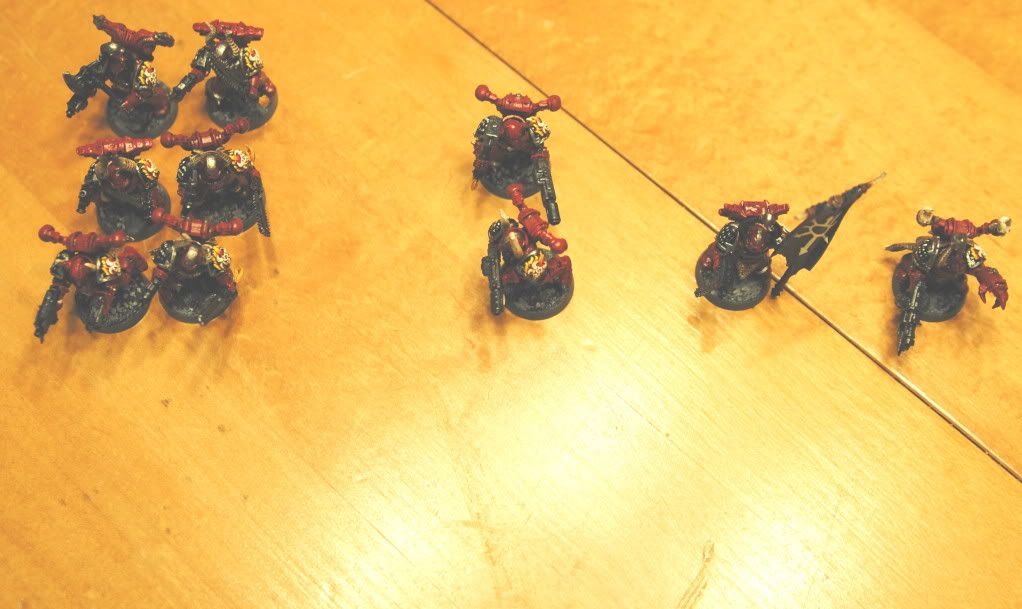
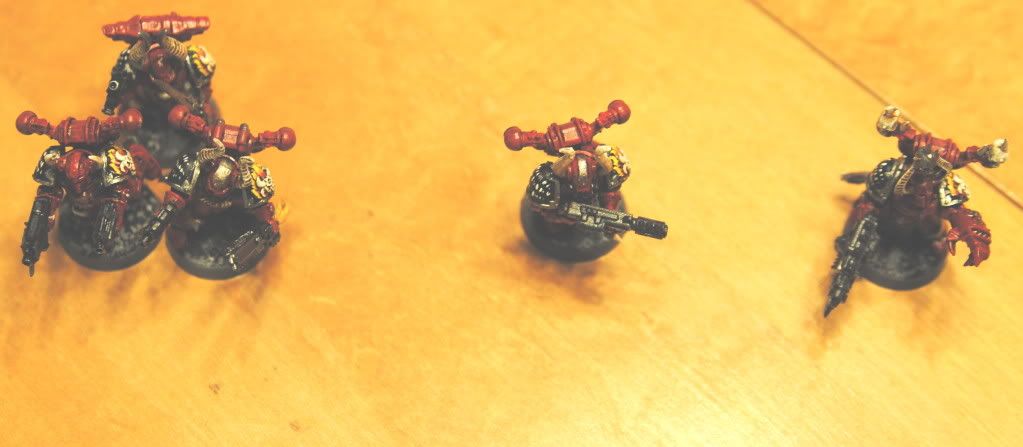
Here's a complicated unit - ten Chaos Marines: six normal, two meltaguns, icon, champion, so four wound allocation groups.


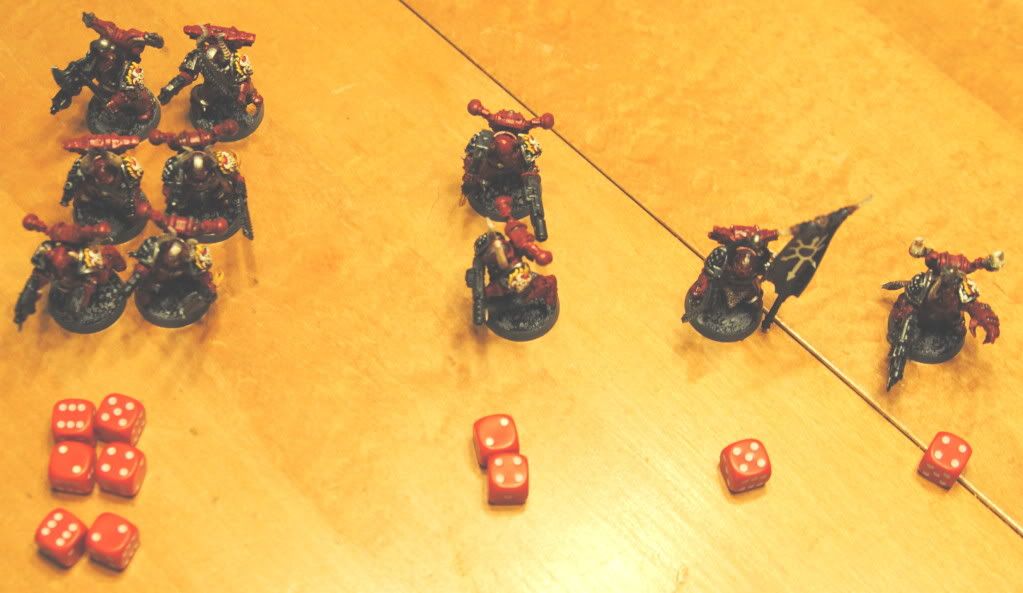
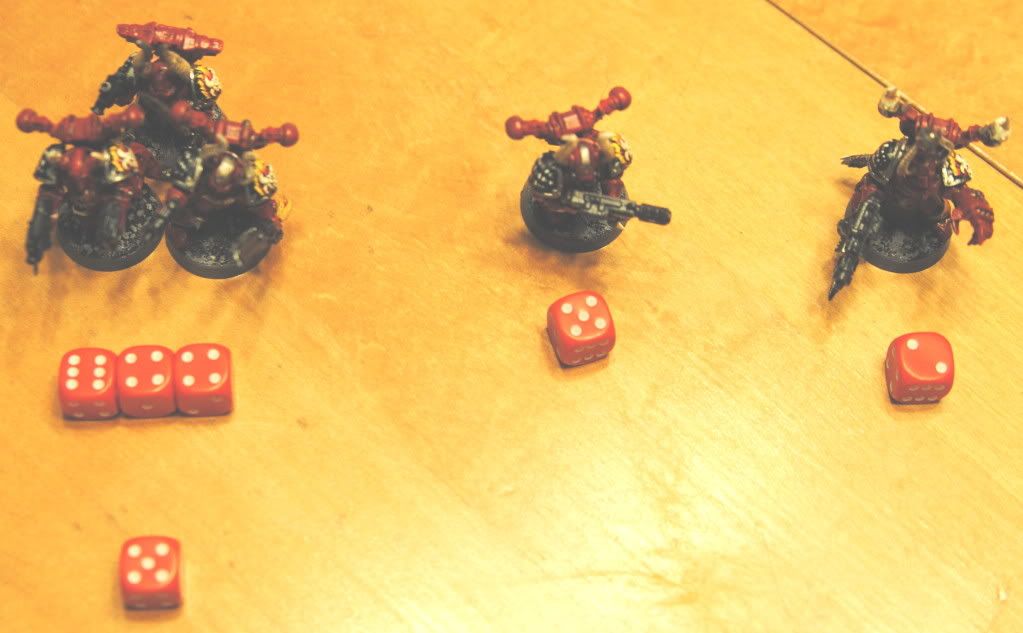
Here's the unit taking ten wounds of the same type.  Each group is full up with one group of wounds.  Six on the bolter guys, two on the meltaguns, one on icon, one on champion.

If we go by the dice results here and say they're normal wounds they get saves against, two bolter guys and one meltagunner will die.


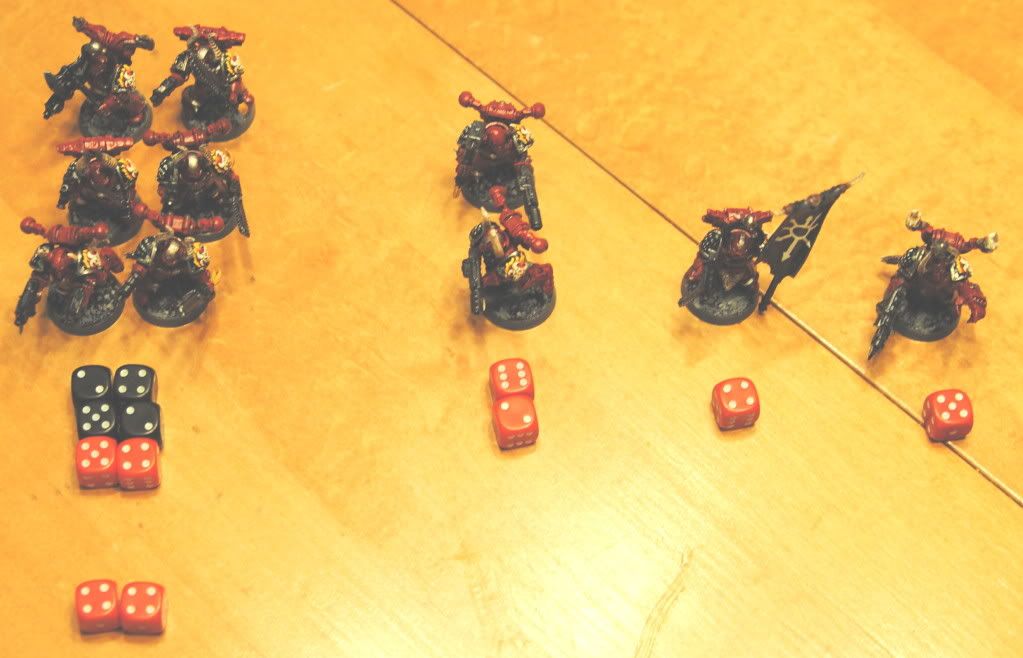
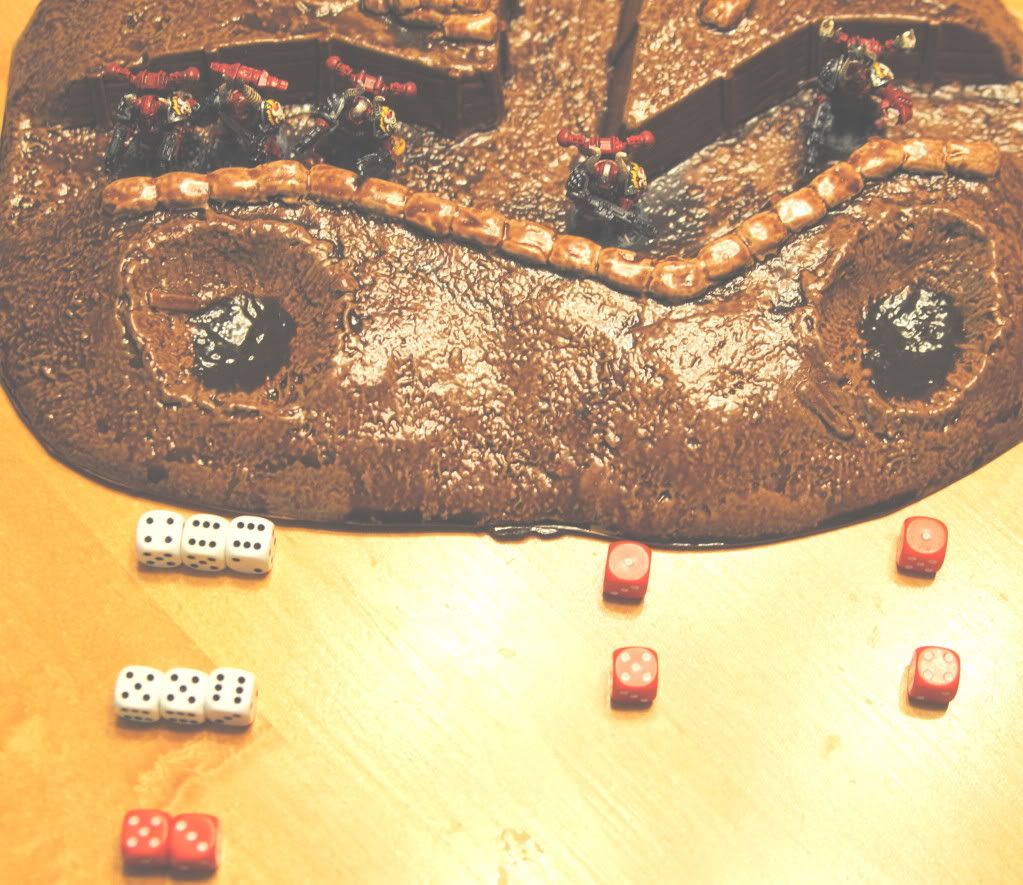
Now we mix it up a bit.  The red dice are still something normal, like lasgun wounds, but now we add the black dice as for example plasma wounds, which will ignore the CSM's armor save. Four plasma wounds and ten lasgun wounds.

All four plasma get allocated to the regular joes, along with two lasgun wounds to fill them out, the meltagunners, icon, and champion each get a lasgun, and with two lasgun wounds left over, they lap around back to the bolter joes.  

If we go by the dice as shown, four bolter guys will die (no save) and one meltagunner also dies from a failed lasgun save.  If you ignored wound allocation in this instance and just did everyone as one large group, you would only have five bolter guys die and the meltagunner would be safe.  Using the allocation properly provides an example of how wound allocation can benefit the shooter, even with mixed AP weapons.

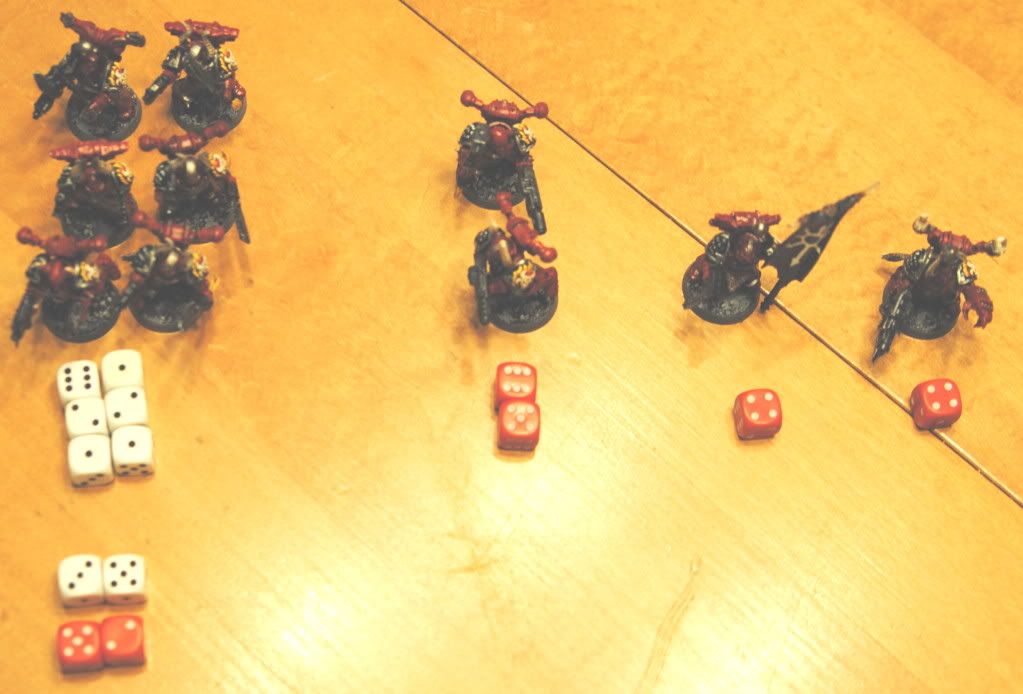
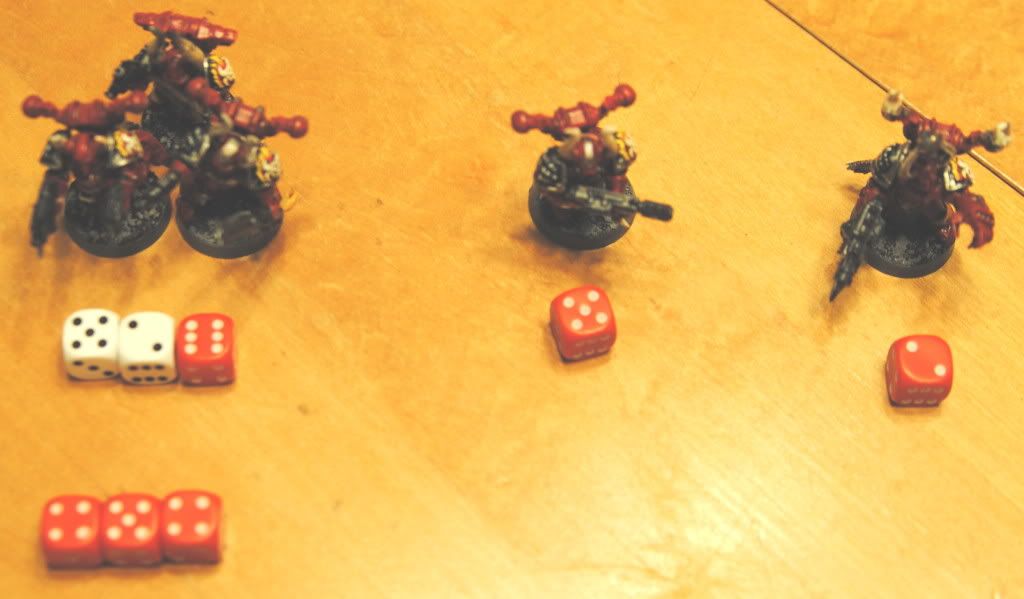
Here's another mixed AP example, this time with the white dice representing the armor-ignoring attacks, and red dice still being normal armor saves.  Say, eight Demolisher cannon wounds, six heavy bolter wounds.  

Six demolisher wounds go on the bolter carriers, and everyone else claims a heavy bolter wound until everyone in the unit has a wound allocated.  Then in the second lap, all of the remaining wounds (two demolisher and two HB) wind up on the bolter carriers.  
With the dice in this example, the bolter guys are wiped out with a little left over, while the other groups are safe.  This is one of the examples those who dislike WA hate; if you just did everything as one group, you'd wind up with nine dead CSM (eight from no-save demolisher, one from failed HB save).  Interestingly though, the CSM player would get to choose which one survived.


Let's make the squad smaller.  Three bolter guys, meltagun, champion - three wound groups.


Basic allocation, six regular wounds.  Each group is full up, and bolter guys get an extra wound.

Using the dice as shown, everyone is OK except for the champion, who bites it.  Without wound allocation, rolling the six saves as one group, you'd just see a regular bolter guy go down instead.  Another example where WA can benefit the shooter.


Bringing mixed AP in again.  Two plasma wounds (white dice) added to the six lasgun wounds.

Two plasma and a lasgun go on the bolter guys, lasgun to meltaguy, lasgun to champion.  Three lasgun wounds left over, wrap back around to the bolter guys.


Here, dice as shown would have two bolter guys die (no save) and the champion bites it again.  Without wound allocation, you'd just see the three normal bolter guys die instead.


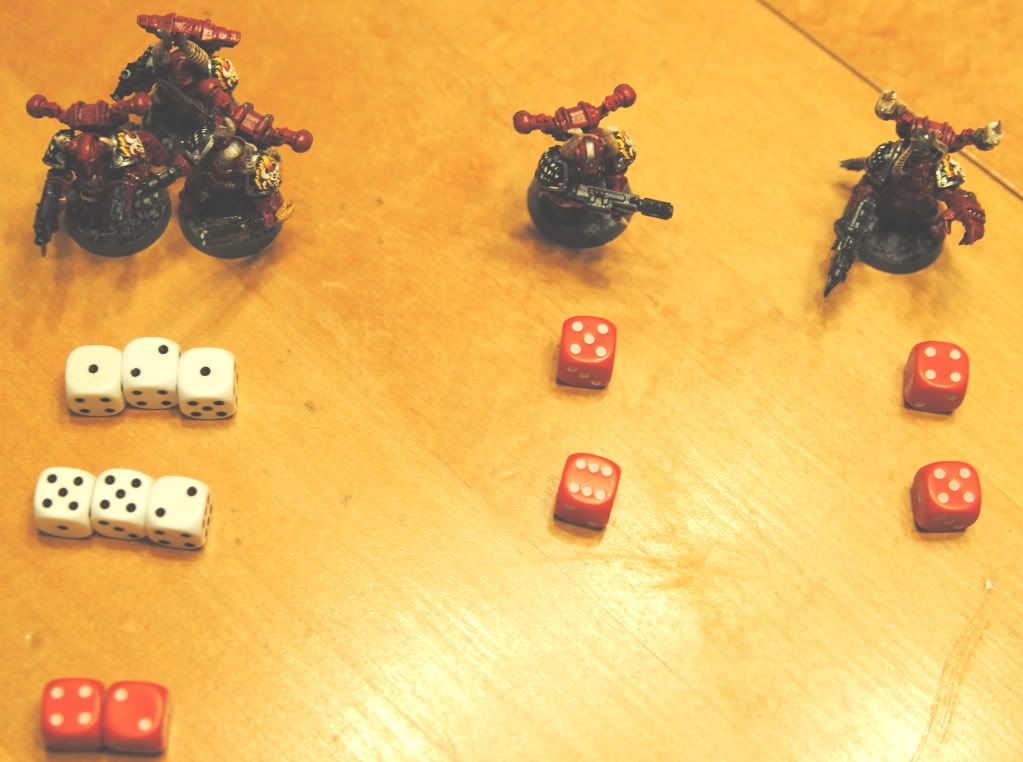
One of the much less likely, but commonly used examples - a bunch of normal saves and a bunch of amor-ignoring ones.  Again, white dice for armor-ignoring shots, like plasma, red for normal shots like lasguns.

Three plasma to the bolter guys, lasgun to melta, lasgun to champ.  Wrap around - repeat three plasma to bolters, lasgun to melta, lasgun to champ.  Two lasgun wounds left wrap around a second time and land on the bolter guys.

This is an example those who dislike WA really hate, as it only has the three bolter guys die, where if you ignored allocation the squad would be wiped out by the plasma wounds.


For the last example, let's tie it in with another of the big 5th-edition hates, cover saves. Here the five-man CSM squad is in a trench, hunkered down for a 4+ cover save.  They're hit as in the last example, with six amor-ignoring plasma wounds and six lasgun wounds, but this time they get to make cover saves against the plasma.

Allocation as previously, but this time the CSM get lucky with their cover saves and unlucky with some lasguns, felling both the champion and the meltagunner but sparing the normal joes.  Without wound allocation, rolling as one big group, you'd see two bolter guys removed instead.


So there's how to do it.  Keep track of how many and what kind of wounds your opponent inflicts, grab some dice, put them in groups, roll, remove casualties.  Try it a few times, it really doesn't take long.  If you try the above scenarios (or others) and roll them out a few times, you'll see that sometimes wound allocation ends up benefiting the attacker, sometimes the defender.

You may or may not like it, and that's your right, but I hope that you won't consider it "too hard".


Related Posts with Thumbnails