Sunday, January 31, 2010

English for Wargamers

OK, I normally try not to be too tight about these things.  But just as a reminder:

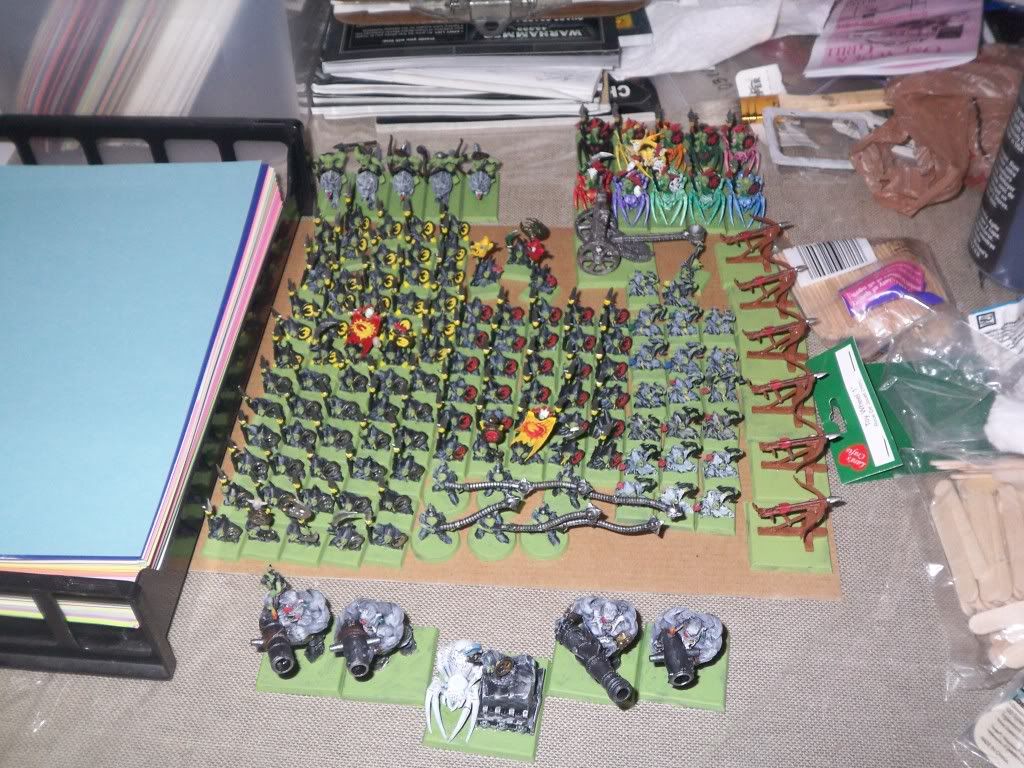
This is a HORDE:


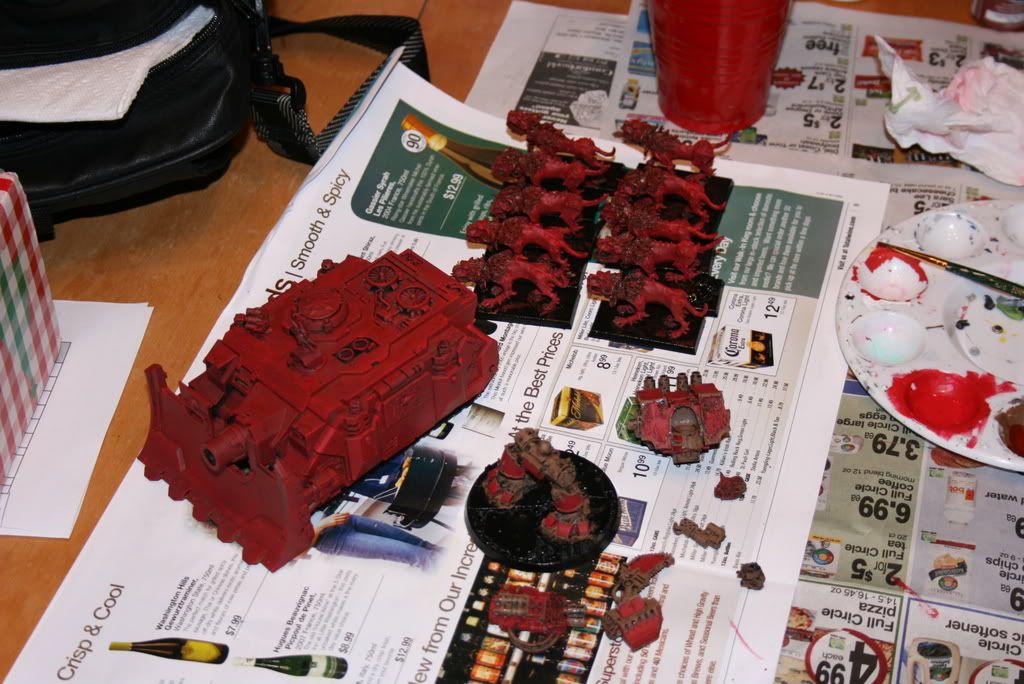
This is a HOARD:

So please, don't go around posting about your hoard of Orcs.

Just remember this simple mnemonic device and you'll do fine:

"The horde of dragons rested on the hoard of gold they had earned from when they whored themselves out."

Army Building - how do you go about it?

Different gamers do it different ways, but in general there's two main ways I've seen.

1) Do the army unit by unit, getting one squad done before moving on to another.

2) Do the army as a whole, getting one stage done on the whole force before moving on to another stage.

I'm pretty solidly in the second camp.  Assembly lines are my friend.  Here's how I go about making a new army:

* Decide what army.
* Fiddle with lists at X point level until pretty satisfied.
* Get the required figs to build that list.
* (Finish other projects)
* Come back to army, start planning.
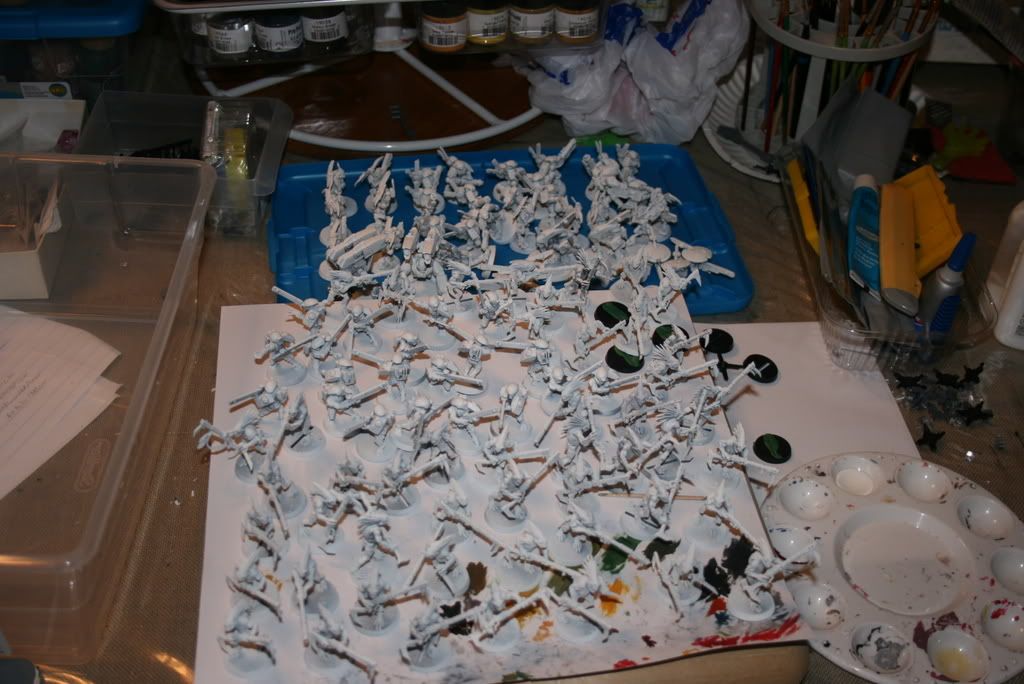
* Clean/assemble entire army.
* Prime army.
* Paint army in stages - undercoat everything, do color A on everything, repeat until fully painted.
* Washes/drybrushing/highlights on everything.
* Base and seal everything.

 
I vary it a bit sometimes, and often will do a test figure first so I'm not flying blind.  But by and large the army gets done in big batches of one stage at a time.


For me there are definite advantages for doing it this way.  I get the whole force done at once.  A lot of the time I can spend painting is in short bursts, so being able to just do one thing for me makes for the most productive use of that time - less time opening and closing paints, cleaning brushes, mixing, pulling out and putting tools away, etc.  It may seem like just a little, but it adds up. 


There's definitely advantages for the other way, going unit by unit.  For some the sense of accomplishment and progress is better when they can see part of the army completely finished.  If you're a stickler for playing only with painted figs, it allows you to play games with the army sooner - paint up 500pts, play games, paint up another 500, play games, etc.  And if you want to get started on an army but can't afford to buy it all in one shot, this can definitely be the way to go.  Buy squad, paint, buy another one, paint, etc.


Which way do you do it?  Do you break it down by stages or by unit?  Some other method?


Thursday, January 28, 2010

Secret Goals - Spicing up the Standard Missions

A while back I thought about a way to help spice up the standard missions (Capture and Control, Seize Ground, Annihilation), and thought I'd share it here too. 

Secret Goals

- Takes the standard mission objectives with a twist - you don't know what the other guy's goals are!

* Take counters/slips of paper with Annihilation, Capture&Control, and Seize Ground indicated on them. Best if have full set for each player. Each player secretly pulls one goal blindly. Keep the marker face down somewhere, to be revealed at the end of the game.

* Roll for deployment type/table sides. Then place 2+d3 objectives on the table. One must be in each deployment zone (players should start by placing these two) and can be within 12" of the table edge, otherwise follow the Seize Ground placement rules.

* Play game!

* At end of game, each player reveals their goal. To determine victory, compare results.
*Seize Ground - use all objectives to determine
*Capture&Control - use only the objectives in the DZs to determine
*Annihilation - use Kill Points to determine

*Does player achieve their goal? (More KP, objectives)
*Player 1 Yes, Player 2 No = Player 1 Victory
*Player 1 No, Player 2 Yes = Player 2 Victory
*Player 1 Yes, Player 2 Yes = Draw
(For these purposes, consider a draw for individual goals to be "no")

Example: Player 1 has Annihilation as his goal and gets 8KP to Player 2's 6. Player 2 has Capture&Control but each player controls one of the objective, resulting in a draw for that goal. End result - Victory for Player 1.

I think this would also work well in a tournament setting.  Each player gets a card with each goal type, and can choose which one to use for each game, but can only use each one once. Turn in your goal card with results sheet after each round.

I haven't had a chance to try it out myself, but think it would add an extra level to the game, as you don't know what the other player is going for, so have to watch out for all options.  You could also do a lot of faking-out, looking like you're going for objectives in order to draw the enemy out so you can kill them for your Annihilation goal, etc.  In a tournament setting, at least in the first couple of rounds you'll be able to choose the mission you think you'll have the best shot at against the opposing army - but so will the other player!

What do you think?  If you use it, please come back and let me know how it goes!

Wednesday, January 27, 2010

War of the Worlds: Goliath

Would you like a movie with alien death rays, flying aircraft carriers, walking tanks and Teddy Roosevelt?

Then this is for you! 

I heard about this a few months ago, and with the original release date (Feb) approaching, thought I'd make sure folks were aware.  Apparently has been pushed back a few months, but hopefully will still be out in 2010.

Sunday, January 24, 2010

Myths about 40K Fifth Edition

5th Edition 40K Myths

I read them all the time online, and you probably do too - the great myths about fifth edition.

I don’t think that the current edition is perfect, but a lot of the common complaints don’t hold up to scrutiny. Let’s look at a few of the more common ones.

5th ed changes are weighted towards shooty/assaulty armies!

Let’s look at the big changes that are weighted towards different kinds of armies:
*Pro-shooty – able to see/shoot through area terrain, no consolidation into fresh combats
*Pro-assaulty – Run, better transport rules.

So assaulty armies will be able to close a little faster, but shooty armies will be able to fire at them more on the way in due to not being able to completely hide as easily, and the assault army won’t be able to chain-assault across the whole enemy line as easily as before.

On balance, to me it looks like it evens out.  Since I hear players of both shooty and assaulty armies complain about it, I think it’s probably pretty well balanced.

Everything grants a 4+ cover save!  Why do guys in tall grass get the same kind of cover as those in ruins?

Actually, they don’t. If you go by the suggestions in the main rules, a lot of things do indeed grant 4+ cover. But not everything does – a number of things are 5+ or even 6+.  One of the most important things you can do before a battle is go over the terrain with your opponent and agree on what everything counts as – cover saves, difficult or not, dangerous or not, etc. If you decide to make it all 4+ that’s certainly an option for you, but it’s not 5th edition’s “fault”.


Speaking of terrain, this new TLOS sucks!

Back in 4th ed, there was an abundance, even overabundance of “just call it area terrain”. That piece of green felt? Yeah, that’s a forest, I’m behind it so you can’t see me. Other than that, everything else already used “TLOS”! Unless you previously designated all terrain as infinitely tall sight-blocking area terrain, you were already using TLOS but just didn’t call it that.

Again, if terrain bothers you, go over it with your opponent before the game and come up with an agreement. It’s in your hands. If you want to make that forest represent three-mile tall redwoods with impenetrable mist between the trunks, go right ahead.


Fearless sucks due to No Retreat! I’d be better off not being Fearless at all!  It’s a disadvantage!

Fearless most certainly does NOT suck. It is 100% an advantage when getting shot at, allowing you to ignore all those morale and pinning checks, allowing you to auto-pass tank shock tests, etc. Someone shooting at your Fearless unit holding an objective will have to kill every last one of them, compared to non-Fearless units that might run off.

A good way to avoid No Retreat wounds is to be more careful about what assaults you get your Fearless units into – make sure that you will win, barring bad luck. Even if you lose by a few wounds, you get saves against those wounds – and for units like Berzerkers or Plague Marines (who also get FNP…) it’s no big deal. The real crying comes in when you lose big on a weak unit, and those Ork Boyz or Guants have to take another 10 wounds. But guess what? If you WEREN’T Fearless, you’d be making a morale check at -10 or have the chance of being run down and completely destroyed.

Anyone with Fearless units that thinks they’d be better off without it is welcome to ignore Fearless when they play me. After a few of their units are forced to fall back or are wiped out by sweeping advances I think they’ll change their mind.


Victory Points were totally fair - they should use them instead of Kill Points!

Kill Points aren’t perfect, I’ll readily admit that. But I think a lot of people are looking back at 4th ed VP games with rose-tinted auspexes. Remember VP denial armies, whose main goal was to do a little damage and then spend the game hiding and running away? Remember killing 40% of a squad and getting no VP? Remember killing 90% and only getting half VPs? There were just as many situations in VP games that could lead to apparently illogical results as there are in KP games.

What do you folks think? Myth or reality? Are there others that you frequently hear that you’d like to debunk?

Tuesday, January 19, 2010

Counts-as Army ideas, part 13 - Witch Hunters

Inquisitors - strange individuals with heads full of forbidden knowledge, leading around packs of strange companions and calling upon support from various forces.

Sounds like an old British sci-fi series...Doctor Who!

The Doctor / Time Lord (Inquisitor Lord)
- With some high-tech gear and a bevvy of strange companions (henchmen).

Gallifreyan Shock Troops (Sisters of Battle)
- Good armor and guns, funky time-lord tech abilities to change time represented by faith points.

UNIT allies (Inducted Guardsmen)
- Led by the stalwart Brigadier.

Throw them up against some Cybermen Necrons and you're good to go!

Would also work well as mainly an IG "UNIT" army with an allied Time Lord.

OK, that's it for the series for now.  Passed over a few due to unfamiliarity, and I'll let the readers (both of you) be the judge on how well the various ideas work.  Even if you don't use any of these specific counts-as ideas, I hope it helps to get the wheels turning in your own head for some fun and unusual armies!

Monday, January 18, 2010

Planning for the Long Haul - 40K over the years


As a 40K player, you almost certainly fall into one of two groups.  One, you're a "veteran" player who has seen at least one edition change in the core rules and more than likely (certain armies like Dark Eldar aside...) has seen at least one change in your particular army's codex.  Or two, you're a relatively new player who hasn't been through the turmoil of edition changes yet.

Either way, there's a good bit you can do to protect yourself against that turmoil.  More than likely, Games Workshop will continue to change the core rules every 4-6 years and periodically update codexes.  So, what can you do?

You have a few choices.

1) Ignore the changes  - If you mainly play with a small group of similarly-minded players, this can work.  I'm sure that there are groups out there that still play 4th, 3rd, 2nd ed or even Rogue Trader, or play 5th edition rules using 3rd ed codexes, etc.  But if you play out in the larger world or plan to attend outside events like tournaments this strategy won't work too well.

2) Buy lots of new stuff each time things change - There's a new uber-unit in the new book?  Buy three.  This other unit isn't as good anymore?  Sell it or put it in storage.  If you have the money to do so and the time to put it all together/hopefully paint it this can work for you.  Some even enjoy retooling their army periodically, like replacing their engine for optimal performance.  But if you have limited money or time, this may not be the best strategy for you, rebuilding the same army at 1500-2000pts over and over again over the years.

So we can either ignore the changes or throw ourselves into them.  Can we find a middle ground?  Yes!

3) Plan for the long haul - Warning: this usually won't result in you having the "best", most competitive force out there.  It is however designed to hopefully give you an army that will transition rule and army changes as smoothly as possible, allowing you to continue playing your army with a minimum of adjustment/unit changes.


So how to prepare for the long haul?

1) Pick an army you really like - Don't just pick an army because you think their current rules are powerful - if you do, there's a significant chance when the rules change you'll be disappointed and will have a greater likelihood of shelving or selling the army at a loss.  Rather, pick an army that you like the idea of, that you like the story of, the look and feel of the army.  If you love the army, you'll continue with them over the years rather than dumping them and sniffing around for the next daemonette.

2) Stay centered as much as possible - Each army has a core that will most likely continue throughout future changes.  The closer to stick to that, the easier your transitions will be.  When preparing for your new army, don't just look at the current book - take a peek at the previous ones (generally 3rd ed on) to see what types of units generally stick around.  If you don't have the books already, ask around in your local group or you can probably find outdated codexes cheap online.  So for Space Marines for example if you build an army with a core of tactical squads, some terminators, an assault squad and some vehicles you could probably build that force with a minimum of fuss in any of their books from 3rd ed to the present.  The easier your proposed army would fit into earlier books, the likelier it is to fit more easily into future editions as well.  This does mean however that army builds that go strongly in one direction may have a hard time adjusting - the more extreme you build in one edition, the greater your likely adjustments for future ones.  If you really like lots of Nob Bikers, or Sternguard, or the rules granted by a particular special character like Vulkan, by all means make that army.  Just don't be surprised when things change in a few years.

3) Take your time modeling and painting - This one has nothing to do with rules changes directly.  However, no matter how well you "center" your army, you may end up having to make minor changes, or decide that you want to add a new unit to your collection when that spiffy new kit comes out.  Over time, you'll be getting more hobby practice in and your painting and converting skills will naturally improve over time.  If your earlier efforts are sloppy and rushed, the new unit done at your new and improved skill level will look out of place with the rest of your army.  If your earlier efforts are well done (for your skill level at the time), that new unit may still stand out, but it will be as a centerpiece rather than an anomaly.  Be patient with your painting, and try to do what I fail to do - keep notes on what you did to achieve colors/effects - note down what paints/washes you used, what mix ratios, etc.  Take a few minutes early on instead of trying to remember how you did it five years later!  Of course these days, putting such things up on a blog or a project log on a website can work as well, but I'd also put it down on paper somewhere too, just in case that site goes under down the road (heaven forbid!).

4) Keep your options open - Purely modeling advice, but it can save you frustration and money.  Where possible, magnetize!  Being able to turn your Predator Annihilator into a Destructor or your Rhino into a Razorback at a moment's notice can save you lots of hassle down the road.  Aside from sponsons, etc. consider magnetizing various upgrade uptions, like hunter-killer missiles, havoc launchers and the like.  Not only does this make WYSIWYG easy, it's also an easy way to represent destroyed weapons by just pulling them off!  You can also do this with infantry models also, enabling you to swap out a meltagun for a flamer, etc.  Also, keep a "bits box" - don't throw anything away!  Next edition you may want those extra plasmaguns, jump packs or whatnot you're not using right now.  Third bit of advice, which ties into the other two - where possible buy the "bigger" kit.  Check out contents on various vehicles and see what you're getting.  A lot of the time you end up with more for your money, like buy a Razorback kit for $5 more than a Rhino kit - you can still make a complete Rhino, but you also have the option for a Razorback and/or have extra parts to use for other conversions.

A couple of examples from my own armies:

Space Marines: My Silver Skulls were my first completed army upon my return to 40K in mid-3rd edition.  Using the 3rd ed codex, I built them as a full drop-pod force, back in the days when drop pods didn't have models or fancy rules to keep you alive while deep-striking into dangerous positions.  I had a number of power-armored squads, a land speeder and two dreadnoughts.

Today I have a number of power-armored squads, a land speeder, and two dreadnoughts.

What had to change? I added a few figures and consolidated squads in order to bulk up the squads to ten men each from the prior seven each, giving me 5 ten-man squads instead of the old 7 seven-man squads.  With the option to break up the units into combat squads I can still cover a lot of real estate.  I also needed physical drop pods.  End result, my actual unit choices were pretty "core" and required minimal changes.  My army style - all drop-pod, was extreme for the time and was vulnerable to the change requiring physical pods on the table.  Thankfully, some cheap scratchbuilds later and I was ready to go.  I decided later to swap out my scratchbuilds for other (though non-GW) models, but I didn't really have to.  The army also grew points-wise from 1500 in 3rd ed to 1850 in 5th, with the bulk of that increase coming from the cost of the pods themselves.

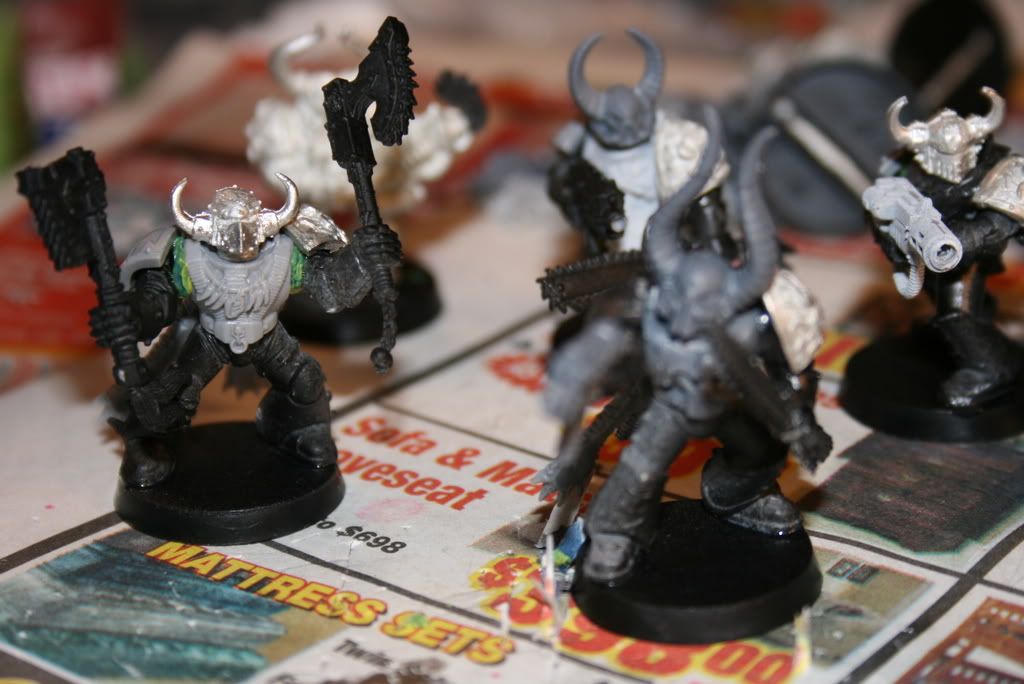
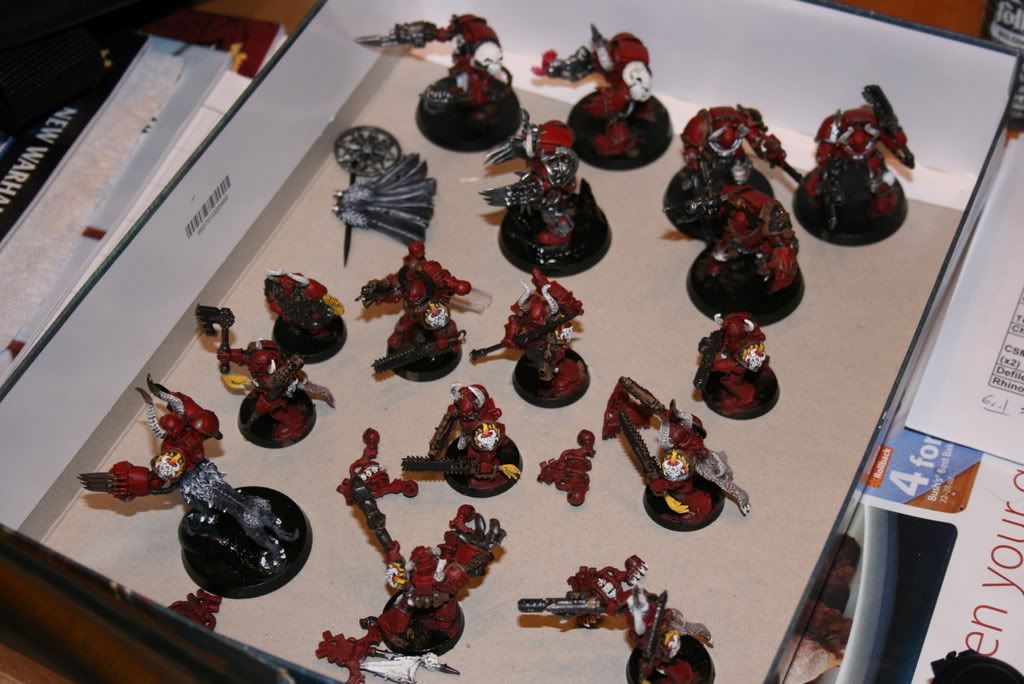
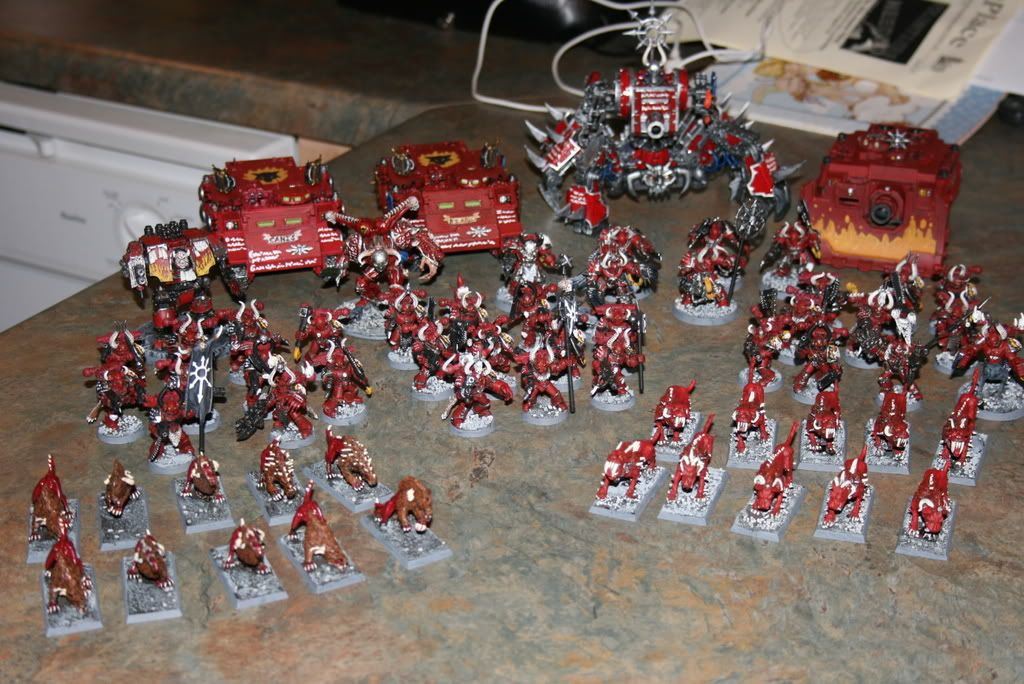
Chaos Marines: I started planning my Word Bearers out under the 3.5 version codex.  I planned on a couple of squads of basic Chaos Marines with Rhinos, an infiltrating squad, a Daemon Prince, some terminators, dread, defiler, and a couple of squads of Flesh Hounds.  Then the 4th ed codex came out and I had to redesign them.

What had to change? Despite the general internet doom and gloom about the 4th ed Chaos codex, not much changed.  My Prince wasn't as powerful, but became a good bit cheaper.  My regular squads were pretty much OK, and my infiltrating squad morphed into Chosen.  Flesh Hounds were gone, but I could still use the models as generic lesser daemons - not as powerful or fast, but significantly cheaper.  The extra points saved helped pay for a vindicator, a new option for non-Iron Warriors armies.  When 5th ed rolled around the Chosen got an extra treat with the option to Outflank, and the Daemons carried over as cheap scoring units in the Troops-only scoring environment.  If I had opted for something like an Emperor's Children force with maxed-out sonic Havocs or something similar I'd have been much more put out.

So do what you can to plan ahead!  As they say, the only constant is change, so be aware and prepare!

Saturday, January 16, 2010

Local Tournament Report Link

Link to report on my experiences at local tournament:

LINK
Related Posts with Thumbnails